
Presentation Schedule

Online Forum: Generative AI and Legacy Media: Potentials and Pitfalls
This presentation will be live-streamed via Zoom (Online Access)
Saturday, 8 November 2025 16:25
Session: Conference Featured Session
Room: Live-Stream Room 1
Presentation Type: Forum Discussion
Disinformation through social media is at a crisis point in Asia and throughout the world (Surjatmodjo et. al. 2024). Legacy media, or traditional forms of media that existed before the internet, plays a key role in addressing the root causes of fake news and hoaxes by amplifying credible and reputable sources, and providing information to inform the populace. However, as newsrooms rapidly embrace generative Artificial Intelligence (GAI) tools to create content or perform tasks based on input computer data (Fletcher & Nielsen, 2024), ethical concerns arise about whether algorithmic biases tied to structural factors, such as gender, race, or class, will exacerbate misogyny, hate speech, and fake news on and offline (Thompson, 2023). This could lead to stereotyping and physical harm against minorities, migrants, women, gender-diverse groups, and culturally and linguistically diverse communities. This Forum session invites delegates to discuss the following questions: Can legacy media play a part in building a future free from misinformation? What are the potentials and pitfalls in the use of AI by legacy media? How can legacy media be used in the institutions and classrooms in which we work and engage with others in an effort to combat disinformation spread by GAI?
Biographies
Virgil Hawkins
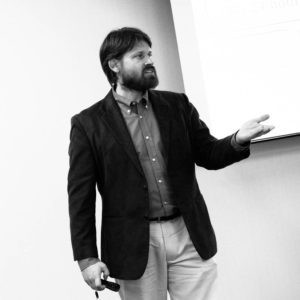
Dr Virgil Hawkins is a professor specialising in world affairs and the news media, and is based at the Osaka School of International Public Policy (OSIPP), The University of Osaka, Japan. He obtained his PhD in International Public Policy from OSIPP, where he focused on international politics, conflict, the UN Security Council, and the news media. He proceeded to work for five years for a non-governmental aid organisation, primarily in Cambodia and Zambia, before returning to the university as a faculty member. He has written and edited a number of books, including Stealth Conflicts: How the World’s Worst Violence is Ignored (2008), and Communication and Peace: Mapping an Emerging Field (co-edited, 2015). His work focuses on furthering our understanding of how and why the vast majority of the world remains relatively uncovered by the news media.
To these ends, Professor Hawkins has since shifted his focus to work at a more practical level. He co-established the Southern African Centre for Collaboration on Peace and Security (SACCPS) (saccps.org) in 2010, which is a network that has brought together researchers and practitioners working on these issues throughout the region. He went on to establish Global News View (GNV) (globalnewsview.org), a large-scale media project that analyses trends and deficiencies in the world news coverage by the Japanese news media, and attempts to compensate for those deficiencies by providing analysis on undercovered global issues.
Melina Neophytou

Dr Melina Neophytou is the Academic Operations Manager at IAFOR, where she works closely with academics, keynote speakers, and IAFOR partners to shape academic discussions within The Forum, bring conference programmes together, refine scholarship programmes, and build an interdisciplinary and international community. She is leading various projects within IAFOR, notably The Forum discussions and the authoring of Conference Reports and Intelligence Briefings, and she oversees the Global Fellows Programme.
Born in Germany and raised in Cyprus, Dr Neophytou received her PhD in International Development from Nagoya University, Japan, in 2023, specialising in political sociology, the welfare state, and contentious politics. She received an MA in International Development from Nagoya University, with a focus on Governance & Law, and a BA in European Studies from the University of Cyprus, Cyprus.
Dr Neophytou’s research interests currently focus on how Artificial Intelligence (AI) is changing the relationship between state and society. Her current work examines technologies such as facial recognition (FRT) and biometric surveillance, and how these tools impact freedom of expression, protest, and social policy.
About the Presenter(s)
-Dr Virgil Hawkins is a professor specialising in world affairs and the news media, and is based at the Osaka School of International Public Policy (OSIPP), The University of Osaka, Japan.
-Dr Melina Neophytou is the Academic Operations Manager at IAFOR, where she works closely with academics, keynote speakers, and IAFOR partners to shape academic discussions within The Forum, bring conference programmes together, refine scholarship programmes, and build an interdisciplinary and international community.
See this presentation on the full schedule – Saturday Schedule
Conference Comments & Feedback
Place a comment using your LinkedIn profileShare this Presentation


Comments
Powered by WP LinkPress