

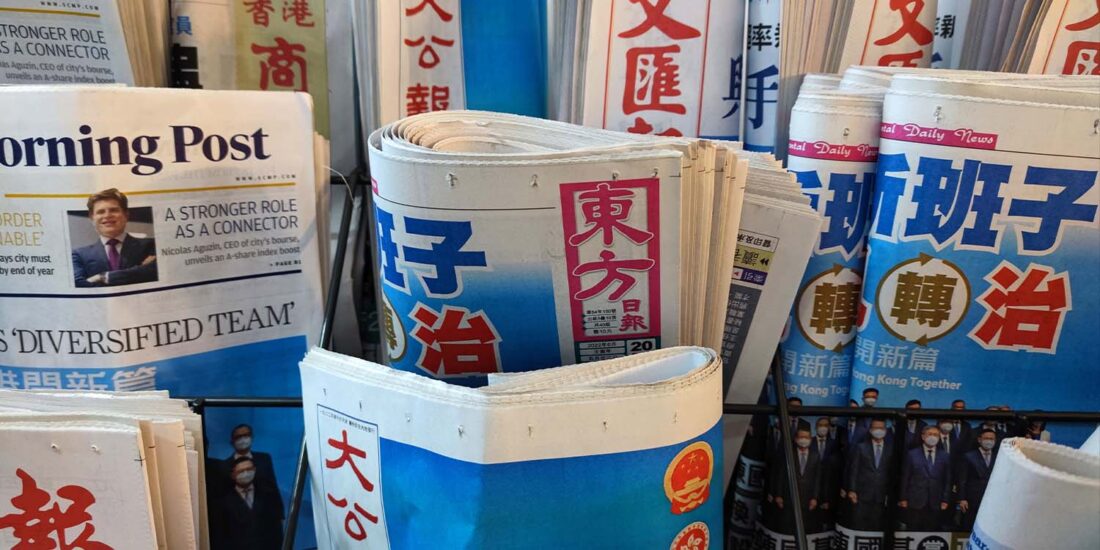
The Asia-Pacific region hosts a diverse range of political systems and perspectives, and complex international relations. Similarly, there is diversity in media and political communications systems of this sector. While there are certainly key differences in how the media functions within countries in this region, state power in any country has an interest in exerting influence, if not control, over the news media, depending on the level aof democracy and media freedoms legally allowed. In the case of Japan, for example, which maintains a democratic political system and a vibrant private media ecosystem, ostensible freedom of the press does not necessarily mean freedom from powerful influence by the political and economic elites of the country. Projections of power cross borders as well: the Asia-Pacific is a region in which relations between countries can be tense and one that is marked by a complex web of relations and rivalries. In this environment, governments in each country work to strengthen media narratives that are perceived to serve their national interests. This panel will discuss the relationship between the media and power in the Asia-Pacific region, in both domestic and international arenas, with a focus on Japan and China specifically. Two presentations will focus on domestic media-state relations in Japan, and one will concentrate on states utilising media narratives from a regional perspective.
The Relationship Between Political/Economic Elites and the News Media in Japan
Azusa Iwane, IAFOR Global Fellow, Japan
In theory, free and independent media plays a crucial role in a democratic society by serving as a watchdog. In this role, the media highlights public issues, informs citizens, and fosters greater public awareness. This, in turn, encourages people to demand higher levels of accountability and transparency from those in power. In practice, however, the media are often perceived to be following the lead of political/economic elites. This presentation will explore such instances, identifying issues of global concern that, although initially unreported by the news media, are widely reported after acknowledgement of their importance by political or economic elites through specific international gatherings and conferences. The presentation will analyse how the agenda on global issues is set by these elites in this manner, using the Japanese media as a case study. The findings highlight how media coverage is influenced by elite interests and the extent of their convergence or divergence.
“Indo-Pacific” or “Asia-Pacific”: Competing Media Narratives among Major Powers
Shuqi Wang, IAFOR Global Fellow, Japan
In the context of “Media and Power,” this presentation will examine the competing narratives among major powers concerning the “Indo-Pacific” concept. The great power rivalry extends beyond the security and economic spheres to media narratives that shape agenda-setting and status-seeking behaviours. This presentation will focus on the competition between China, the United States, and its major allies, such as Japan and Australia, highlighting China’s rejection of the Indo-Pacific geopolitical framework and its active promotion by others. By analysing public media representations, official statements, and strategic communications, this presentation will explore how these states utilise media narratives to strategically frame their regional visions and geopolitical objectives, thereby influencing public perception and understanding. In the competition among major powers, media not only plays a crucial role in constructing and disseminating regional geopolitical discourse but also contributes to broader implications for power dynamics.
Do Japanese Newspapers Fulfil Their Watchdog Role: The Aftermath of the Fukushima Nuclear Disaster
Sonja Viktorija Anić, Osaka University, Japan
In March 2011, a devastating tsunami ravaged the shore of the Tohoku area in Japan, causing an unprecedented disaster at the Fukushima Daiichi nuclear plant. Following this disaster, Japan battled the consequences, from radioactive wastewater to the resettlement of Tohoku residents. A year later in 2012, Shinzo Abe began his second term as Prime Minister of Japan, ushering in a significant crackdown on media freedom and media criticism of the Japanese government reported in foreign media under his tenure. In this study, this claim was tested by analysing editorials concerning the Fukushima nuclear disaster from the three main country-wide newspapers: the Asahi Shimbun, the Mainichi Shimbun, and the Yomiuri Shimbun during the period between 2012 and 2017. Editorials were analysed for topics, angles, and levels of criticism of the government’s response, and any changes thereof. No significant changes were observed in the Mainichi Shimbun, while the Yomiuri Shimbun was positive towards the government’s actions. In the case of the Asahi Shimbun, the newspaper took a firmly critical stance against the government until 2015, after which the critical tone towards the government drastically decreased. This coincided with public pressure and loss of reputation resulting from an incident where the Asahi Shimbun was forced to retract a series of articles, which may have encouraged self-censorship in its coverage of the Fukushima incident.
